
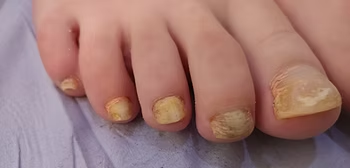
When you notice your big toenail has stopped growing forward and instead appears to be thickening into odd, yellowing layers, it is easy to assume you are dealing with a standard fungal infection. However, at Harley Street Nail Specialist Clinic, we often find that what patients describe as stubborn fungus is actually a much rarer mechanical condition called Retronychia.
It is a condition that many general practitioners and high-street salons simply haven’t heard of, leading to months or even years of misdiagnosis and ineffective topical treatments. Continue reading to know more about this condition and how we can help.
What Exactly is Retronychia?
Retronychia occurs when the nail plate loses its attachment to the matrix (the root) and a new nail begins to grow underneath it. Instead of the old nail shedding, it becomes trapped. As the new nail pushes from below, the old nail is forced backward and upward into the sensitive proximal nail fold.
This results in a triple-layered effect of overlapping nail plates, which triggers chronic inflammation, redness, and often a painful discharge. Because the nail is pushed backward rather than outward, it becomes physically impossible for the nail to grow normally again without specialist intervention.
Why Conservative Treatments Fail?
For many of our London clients, the journey to our clinic follows a familiar pattern: rounds of antifungal paints or antibiotics that provide no relief. This is because Retronychia is a structural problem, not a primary infection.
While we have years of experience and advocate for non-surgical health wherever possible, Retronychia is one of the few conditions where toe nail removal in London is often the only curative path.
By surgically removing the stack of trapped nail plates, we reset the nail bed, allowing a single, healthy nail to finally grow forward unhindered.
The Surgical Approach
At Harley Street Nail Specialist Clinic, we perform this procedure under a local anaesthetic to ensure you are entirely comfortable. It is important to note that while some clinics market lasers as a painless alternative, it is not entirely true or even non-invasive because it leaves a wound, and it is rarely effective for the mechanical stacking seen in Retronychia.
During the procedure, we carefully lift and remove the overlapping layers. Depending on your specific case, we may allow the nail to grow back naturally or, if you have suffered for years with recurrence, discuss permanent removal.
The recovery is surprisingly straightforward, and most of our patients are back in their usual footwear within a few days.
Trust Our Expert Care for Complex Nails
If you are tired of a fungal nail that refuses to heal, it may be time for a specialist diagnosis. Our lead podiatrist, Marion Yau, specialises in these difficult cases that require more than just a standard pedicure.
Do you need consultation for toe nail removal in London because you detect you have Retronychia? Contact us for guidance.